Case: Brainlab Cranial planning, generate a 5 arcs plan, when export to Mosaiq then TrueBeam, Arc 2 MLC error message, MLC invalid, dose anyone out there encounter this error before? Any input is appreciated

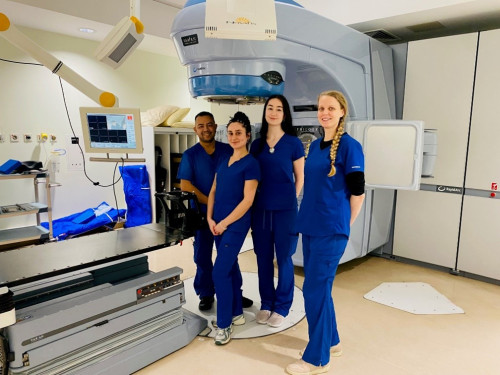
St. Luke’s Radiation Oncology Network: Leveraging Brainlab advanced stereotactic planning and image-guided patient positioning and monitoring to support brain and spine radiosurgery.
As Ireland’s largest public radiation oncology provider, St. Luke’s Radiation Oncology Network operates across three sites in Dublin, Ireland. Two of the centers are located on the campuses of major acute hospitals: St. James and Beaumont. The Beaumont Hospital site serves as the national referral center for craniospinal and skull base radiosurgery treatment, delivering specialized care for complex intracranial and spinal conditions.
The challenge: Achieving the seemingly unachievable. With rising demand for both intracranial and spine radiosurgery, the Beaumont RCSI Cancer Centre team needs to deliver precise, consistent treatments in both routine and high-risk scenarios while maintaining efficiency across a high-volume clinical schedule. This becomes especially critical in spine radiosurgery, where clinicians aim to deliver a sufficiently high dose to control the tumor while sparing the spinal cord just millimeters away. Achieving this balance requires a highly advanced algorithm—one that can sculpt dose in a concave target such as the vertebrae and create high-gradient plans that protect the cord without compromising tumor coverage. Once the optimal plan is created, the patient needs to be correctly positioned and monitored throughout treatment to enable intended delivery, with submillimetric accuracy from start to finish if needed. Multidisciplinary collaboration and robust high-quality technology are essential for this busy center that treats many different indications, from purely palliative to extremely complex radiosurgery.
The innovation: “Brainlab technology is deeply integrated into Beaumont RCSI Cancer Centre’s radiosurgery department.” Central to the Network’s approach are Elements Radiosurgery Solutions and ExacTrac, a configuration that supports complex radiotherapy planning, precise patient positioning and monitoring for a wide range of conditions from spinal metastases to intracranial metastases and benign intracranial conditions (including arteriovenous malformations, or AVMs, vestibular schwannomas and trigeminal neuralgia).
The intracranial radiosurgery program began using Brainlab solutions in 2013 and Beaumont RCSI Cancer Centre was the first in Europe to offer frameless radiosurgery treatments for trigeminal neuralgia. Brainlab Elements was introduced in 2018, initially used to treat multiple brain metastases, and became the primary planning platform for central nervous system cases in 2022. Single isocenter planning for multiple brain lesions enabled more consistent scheduling and workflow efficiency for a busy center treating a wide range of conditions.
The Beaumont RCSI Cancer Centre features the St. Luke’s Network’s flagship linac, Delvin, named after a river in Ireland through a patient-led naming initiative. This linac is equipped with ExacTrac which through image guidance allows for reduction in setup margins, making it very attractive to all consultants.
There is constant high demand for Delvin treatment slots and the ability to treat multiple brain metastases with a single isocenter has been practice changing for the Network. Today, nearly a third of the Network’s metastatic brain patients are treated using Elements Multiple Brain Mets SRS with a single isocenter.
Elements Radiosurgery Solutions have become a cornerstone of the Network’s rapidly expanding spine radiosurgery program. Since patients cannot be in the same position for their MR and CT scans, Elements Curvature Correction Spine—a dedicated deformable co-registration tool—enables them to use information from both modalities to better define the spinal anatomy and targets. In combination with AI-powered extra-cranial segmentation, organs at risk can be easily segmented.
In their words: “Our spine radiosurgery service has taken off over the last couple of years. We have designed a country-wide clinical trial to evaluate the safe dose escalation for patients with spinal metastases which is reaching our accrual targets much faster than expected.” — Professor Clare Faul, Consultant Radiation Oncologist at St. Luke’s Radiation Oncology Network.
Plans are generated using Elements Spine SRS, which enables accurate dose plan optimization and calculation with a Monte Carlo algorithm, which the team considers the most significant gain.
“All two-fraction patients are planned exclusively in Elements Spine SRS. Internal plan comparisons show a far better conformity to the target and sparing of organs at risk for those plans created in RT Elements. Possibly the most significant gain is the ability to optimize and calculate with a true Monte Carlo algorithm. With the newest software release, the fast Monte Carlo allows us to optimize and calculate with high accuracy in less than 20 minutes. The dedicated optimizer is extraordinary, too. We have been able to dose escalate in high-risk patients, where over 50% of the target is made of the gross target volume (GTV), without compromising proximal organs at risk. We get very excited every time we achieve the seemingly unachievable.” — Dr. Christina Skourou, Senior Physicist at St. Luke’s Radiation Oncology Network.
Treating so close to the spinal cord, nerve roots and esophagus are inherently challenging. For this reason, early on, the team performed extensive setup validation to establish safe and realistic planning target volume (PTV) margins. They would also acquire multiple CBCTs during each treatment fraction, but as they gained confidence in ExacTrac, they realized they could safely reduce patient imaging dose and shorten treatment time by relying on the device alone for intrafraction monitoring and correction. Today, spine stereotactic ablative radiotherapy (SABR) patients receive one posterior kV image to confirm the correct vertebral level, a CBCT to verify internal anatomy against plan and multiple ExacTrac kV images throughout treatment. Overall, treatment time per fraction is only slightly longer than for conventionally fractionated treatments.
The impact: Expanding access to radiosurgery for patients with complex brain and spine conditions. Together, Elements Radiosurgery Solutions and ExacTrac offer the Beaumont team greater confidence to deliver radiosurgery in high-risk scenarios. Consistent target definition and high-quality dose planning, together with precise patient positioning and continuous monitoring, enable submillimetric accuracy throughout treatment. The high level of accuracy supports evolving treatment pathways and allows radiosurgery to be integrated into clinical decision-making across a wider array of conditions.
St Luke’s Radiation Oncology Network was the first center in Ireland to achieve Novalis Certification, underscoring its leadership in advanced stereotactic radiotherapy. “The Novalis Certified program has played an important role in quality assurance and patient safety at the Network by independently validating that stereotactic radiotherapy is delivered to the highest international standards” — Paul Davenport, Principal Physicist at St. Luke’s Radiation Oncology Network.
Pictures: © St. Luke’s Radiation Oncology Network, Dublin, Ireland
Disclaimer: The statements made by the clinicians represent their personal opinion and experience. These statements may not be supported by scientific evidence or peer-reviewed research. For verified information about the device, please refer to the manufacturer's official documentation.

From a clinical workflow and technology standpoint, I was wondering—given the geometric limitations in ring gantry systems, is the likely direction toward surface imaging with AI-based prediction, or are there ongoing developments for internal tracking within closed-bore architectures?
What troubleshooting steps do you follow when ExacTrac shows repeated positioning deviations despite correct initial setup?


First of all thank you for this platform.
May i know Sir from your experience, what are the most effective strategies for managing intrafraction motion during SBRT, particularly in spine and lung cases?


Big News! 🎉 We are excited to announce that the Brainlab Novalis Circle 10th International Conference is happening on September 17-19, 2026, in the vibrant city of Munich, Germany!
Mark your calendars and get ready for two full days of cutting-edge scientific talks and thought-provoking discussions, featuring some of the most brilliant minds in the world of stereotactic radiosurgery and stereotactic body radiation therapy.
It’s going to be an unforgettable event, and we can’t wait to see you there!
You can find more information here: Novalis Circle Conference 2026 | Brainlab

Exciting News!
Join us in Nashville, Tennessee for the Brainlab Regional Symposium happening November 14 and 15, 2025!
This 2 day symposium will bring together clinicians, physicists, and innovators from across the region to explore the latest breakthroughs in radiation oncology, featuring Brainlab’s cutting-edge SRS and SBRT solutions. From cranial SRS to extracranial treatments like DIBH breast, prostate, and lung applications — there's something for every aspect of clinical practice.
Agenda is coming soon
Click here to register
Looking forward to seeing you there!

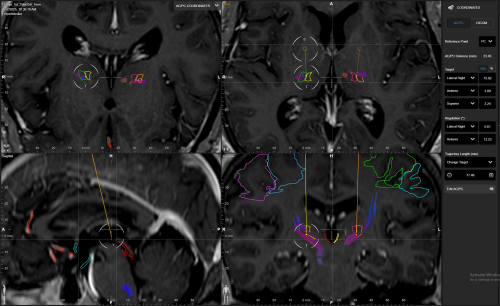
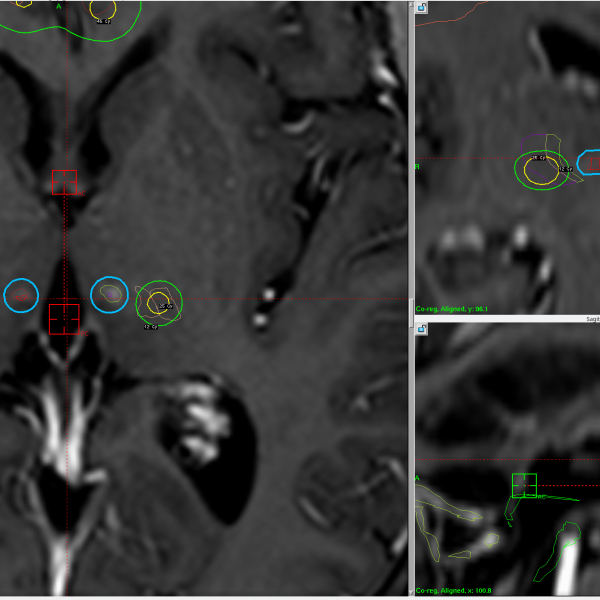
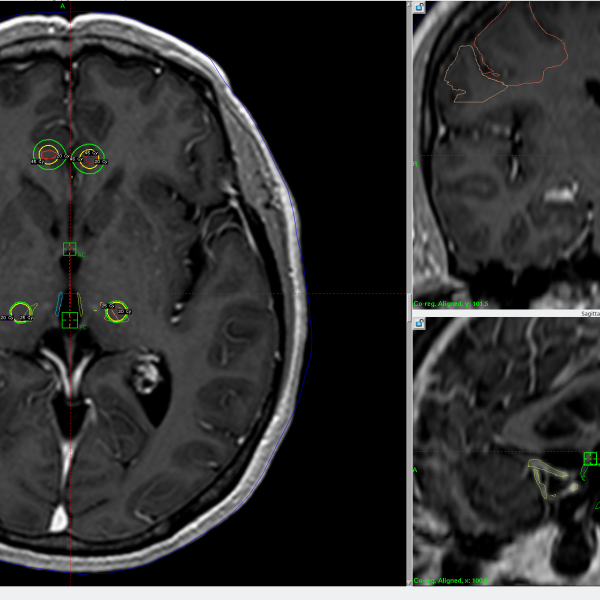
The Most Challenging Case Yet Phantom limb pain: Everything tried over the years at the local and peripheral levels has failed, including active treatment by algology and neuropsychology. Treatments have included an L2-L5 radiosurgical rhizotomy and—as you can see in the images—our most powerful approach: bilateral thalamotomy (120 Gy) and bilateral cingulotomy (90 Gy). We are one year out, and pain intensity is 8 to 10 out of 10.
What to do? This patient—as with so many out there—goes beyond the limits of what is known to medical science. Invasive alternatives are always available, such as attempts at DBS or cortical stimulation (rTMS has failed as well on her), but I believe—and the literature could demonstrate—that they are inferior or at least not superior to radiosurgery, in addition to this they are currently not available.
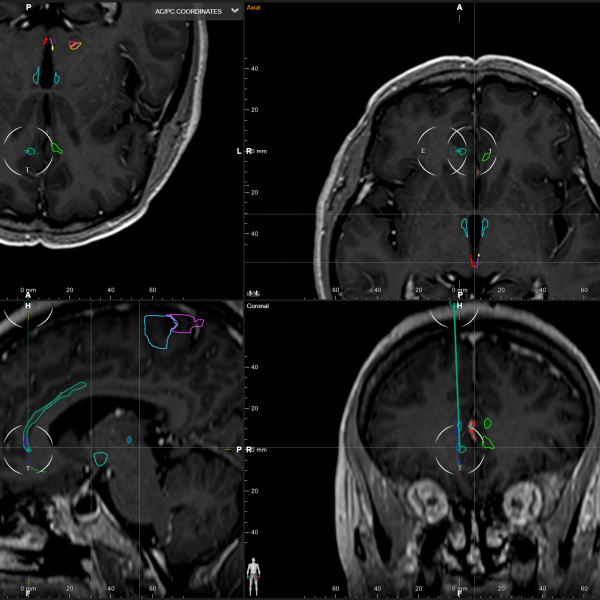
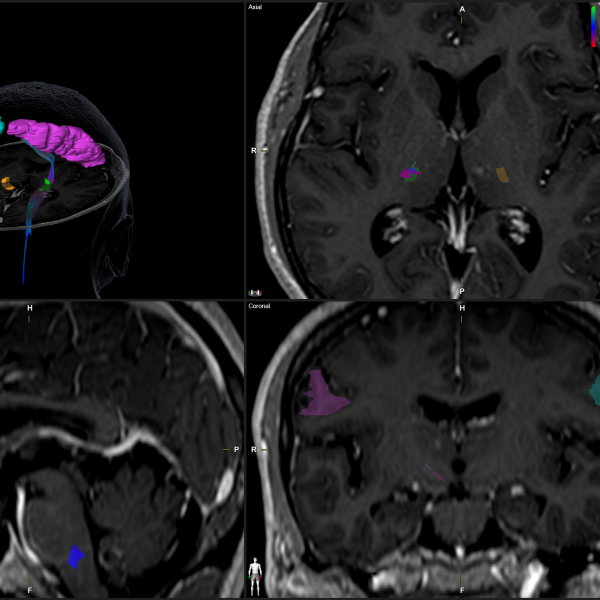
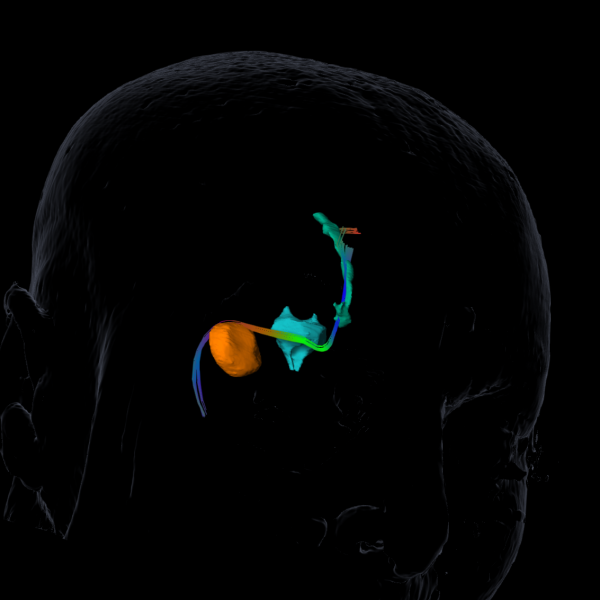
What’s new? Connectomic-based radiosurgery with Brianlab Elemnts. The approach is bilateral irradiation (50 Gy DMax) of the thalamus, but now to the VPL (previously, we used our classic CM-PFc target), and now a subgenual cingulotomy guided by connections to the hypothalamus and amygdala (90 Gy DMax).
What’s with the low doses? Recently, our published data showed how 90 Gy can be necrotic; this patient has contrast enhancement as well where we delivered 90 Gy to the right cingulum at a more traditional “surgical” targeting technique above the corpus callosum. 50 Gy might not be necrotic, but hopefully the 20 Gy isodose line can be modulatory, and this encompasses both the VPL and the VPM.
We shall keep our fingers crossed, hoping we can alleviate this wonderful lady. I'll keep you posted in the upcoming months.